
20 Conversation Starters for Your Next Language Practice Session
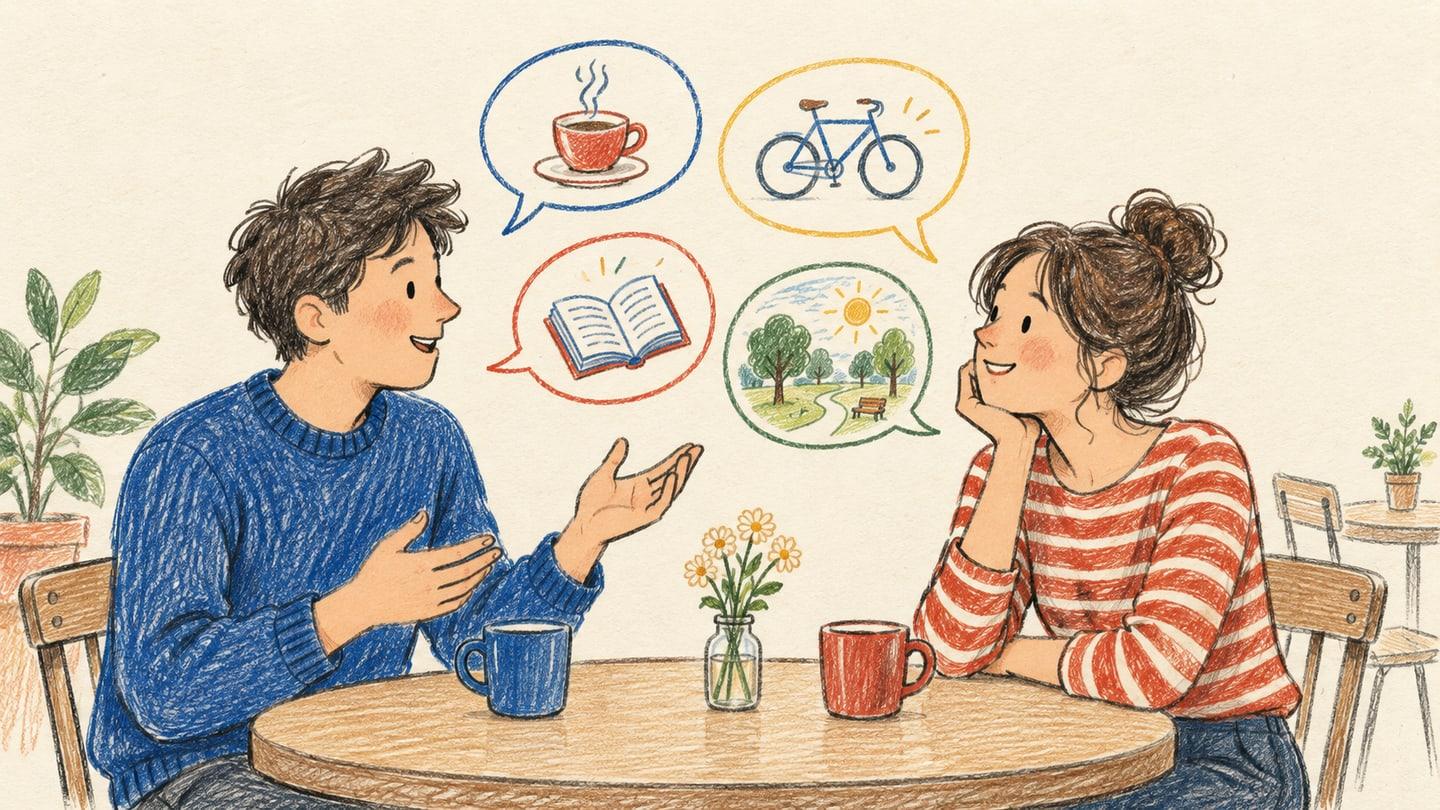
You open a conversation, say hello, and then run out of ideas. You know some words. You just need something to do with them. A small, specific question can give your next language practice session a direction.
Choose one question and stay with it
You do not need to work through this list in order. Pick a question you would enjoy answering yourself, share a little of your own answer, and invite the other person to respond. Food, routines, and hobbies give you plenty to discuss without needing to tell a stranger your life story.
The examples below are in English. If you are learning another language, use them as ideas and build the questions with expressions you already know. A simple version you understand is more useful for practice than an elaborate translation you cannot follow up on.
Everyday life: start with something familiar
- What do you usually have for breakfast? Follow up: Do you make it yourself?
- What is your favorite part of the day? Follow up: What do you usually do then?
- How do you get around your town? Follow up: What do you like about traveling that way?
- Where do you like to go for a walk? Follow up: What can you see there?
- What do you do when you have a free hour? Follow up: Do you prefer doing that alone or with someone?
Just starting out? Offer a choice: “Tea or coffee?” can become “I like coffee in the morning. What about you?” You can have a real exchange with short sentences. Add a reason when you feel ready.
Things you enjoy: give your opinion
- What meal do you enjoy cooking? Follow up: Which ingredients do you need?
- What music do you listen to while doing other things? Follow up: Does it change with your mood?
- What kind of stories do you enjoy? Follow up: Do you prefer reading them or watching them?
- What is a hobby you would like to try? Follow up: What would you need to get started?
- Which season do you enjoy most? Follow up: What is one thing you like doing in that season?
Give the other person something to respond to. Instead of only saying “I like winter,” try “I like winter because I enjoy quiet evenings at home.” Now the conversation could move toward weather, books, cooking, or how you spend an evening.
Small stories: practice talking about the past
- What was one good thing about yesterday? Follow up: What made it enjoyable?
- What was the last new food you tried? Follow up: Would you have it again?
- When did you last change your plans? Follow up: What did you do instead?
- What did you enjoy doing as a child? Follow up: Do you still enjoy it?
- What is something you recently learned to do? Follow up: Which part was difficult at first?
Keep your story manageable: what happened, one detail, and how you felt about it. If past-tense forms are still new to you, prepare two sentences from a pattern you have studied. Save unfamiliar forms to check after the exchange instead of trying to explain your entire weekend at once.
Plans and possibilities: take the conversation further
- What would you like to do next weekend? Follow up: What might change your plans?
- If a friend visited your town, where would you take them? Follow up: Why would you choose that place?
- What would your ideal day off look like? Follow up: How would it begin?
- Which everyday task would you like to find easier? Follow up: What would help?
- What would you like to talk about more confidently in this language? Follow up: Can we try a small part of that conversation now?
Some of these questions use more complex grammar. You can simplify them: “What places do you like in your town?” covers similar ground to imagining a friend’s visit. Choose the version that leaves you enough attention to listen or read the reply.
Turn one answer into a conversation
Think of the questions as openings. After an answer, respond to one detail before asking anything else. Here is an example exchange you could adapt:
You: What meal do you enjoy cooking?
Partner: I make soup on Sundays. I use whatever vegetables I have.
You: I like soup too, but I usually buy it. Which vegetables do you use most often?
Partner: Carrots and potatoes. It is very simple.
You: That sounds like something I could try. How long does it take?
Notice how the last two questions come from the answer. You do not have to invent a new topic each time. A useful rhythm is to react, add something about yourself, then ask about a detail. Leave room for your partner to ask you something too.
If a reply is unclear, pause the topic and ask for clarification. Understanding one sentence well gives you a better starting point than guessing at an entire paragraph.
Try a three-message challenge
Choose one starter for your next Polyglossa text chat. Write your question, respond to one detail in the answer, and send a follow-up. Your goal is to contribute three messages about the same topic, using language you can explain yourself. There is no need to make each message long.
Afterwards, save one phrase you wanted but did not know. Write a sentence with it in a language journal, then bring it into another conversation. That gives your next session a starting point of its own.
For complete short exchanges, try English small talk at work or Swedish conversation at fika.