
How to Explain a Word You Don't Know in Another Language
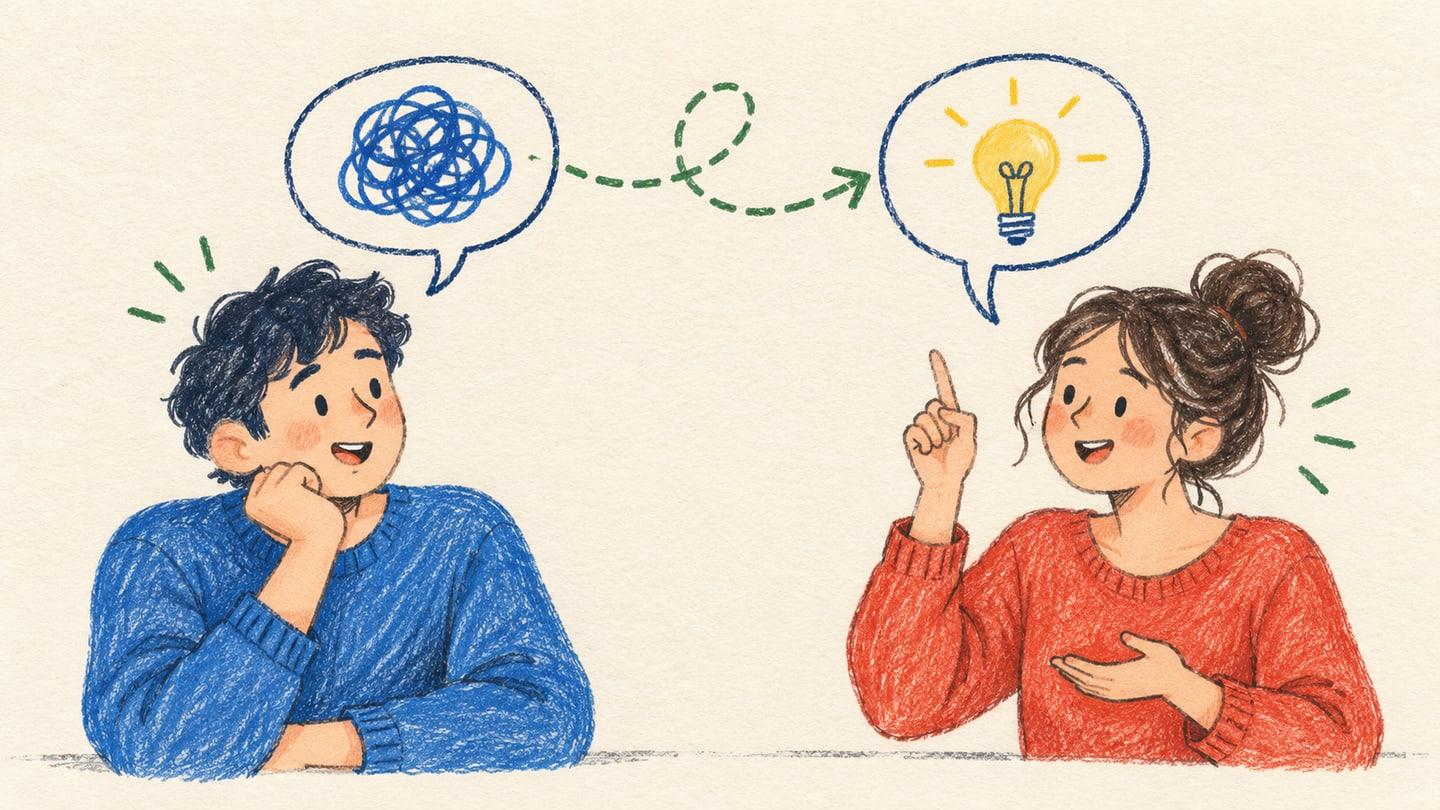
When you do not know a word in another language, explain what it does, what it looks like, or where you use it. A short description can keep the message moving while you look for the exact word.
Use a category and one helpful detail
Try these English frames, then find equivalent phrases in the language you are learning:
- Category: “It's a kind of tool.”
- Purpose: “You use it to open something.”
- Appearance: “It's small and made of metal.”
- Place: “You usually keep it in the kitchen.”
Choose the clues that separate your object from other things. “It is useful” fits almost anything. “You use it to open a bottle” gives the listener a much better chance.
Five everyday examples
- “You hold it over your head when it rains.” Umbrella.
- “It's a kitchen tool for opening bottles.” Bottle opener.
- “You use it to put power back into your phone.” Phone charger.
- “It's the paper a shop gives you after you pay.” Receipt.
- “It's a small soft thing you put your head on in bed.” Pillow.
You do not need all four kinds of clue every time. Start with the simplest useful one. If the other person guesses the wrong thing, add a detail instead of starting the whole message again.
Explain an idea with a situation
Abstract words can be harder to describe. Use a small story. If you forget “disappointed,” try “I really wanted to go, but the event was canceled. I feel sad about it.” That gives the listener the meaning you need now.
If you are unsure whether they understood, ask “Does that make sense?” For help with the other direction—understanding their message—see asking for clarification.
Try ten descriptions
Describe these without using their names: key, fridge, ticket, backpack, mirror, towel, bridge, neighbor, appointment, and patience. Write your answers before reading the possible clues below.
- Key: something you use to unlock a door.
- Fridge: the kitchen appliance that keeps food cold.
- Ticket: something that shows you paid to enter or travel.
- Backpack: a bag you carry on your back.
- Mirror: something you look in to see your face.
- Towel: something you use to dry yourself.
- Bridge: a structure that lets you cross a river.
- Neighbor: someone who lives near you.
- Appointment: an agreed time to meet someone, such as a dentist.
- Patience: being able to wait without getting angry.
Learn the missing word afterward
Check the exact word and save it with your description. Next time, try using the word itself. Description is a way to finish your thought, not a reason to stop learning vocabulary.
Describe one object in a penpal message and ask for a guess. This also fits our exercises for writing without translating every sentence.